The history of the AGL
Explore the achievements and successes of the AGL as well as some key dates. The further back we go in time, the more we will only indicate the main or best-documented facts. Beyond these highlights, the AGL is a daily effort to defend student rights, with major actions occurring when consultation does not yield results.
It is possible to consult all the periodicals published by the AGL since 1961 at the UCLouvain archiving service, which allow us to understand the reality of students and society in general over the ages. Since 2024, the physical archives of the AGL are also located there.
History of the AGL logos
1968

1986
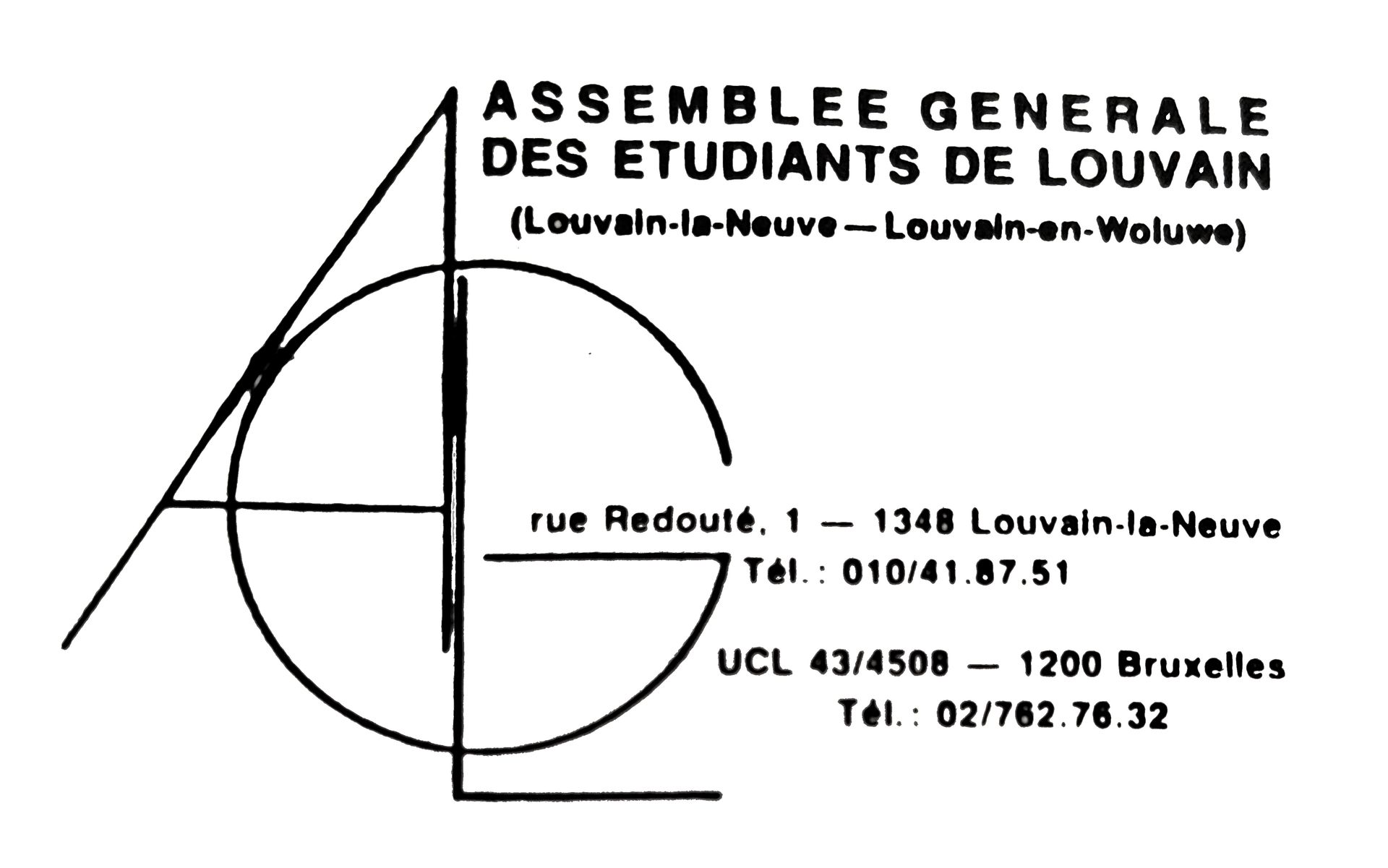
1988
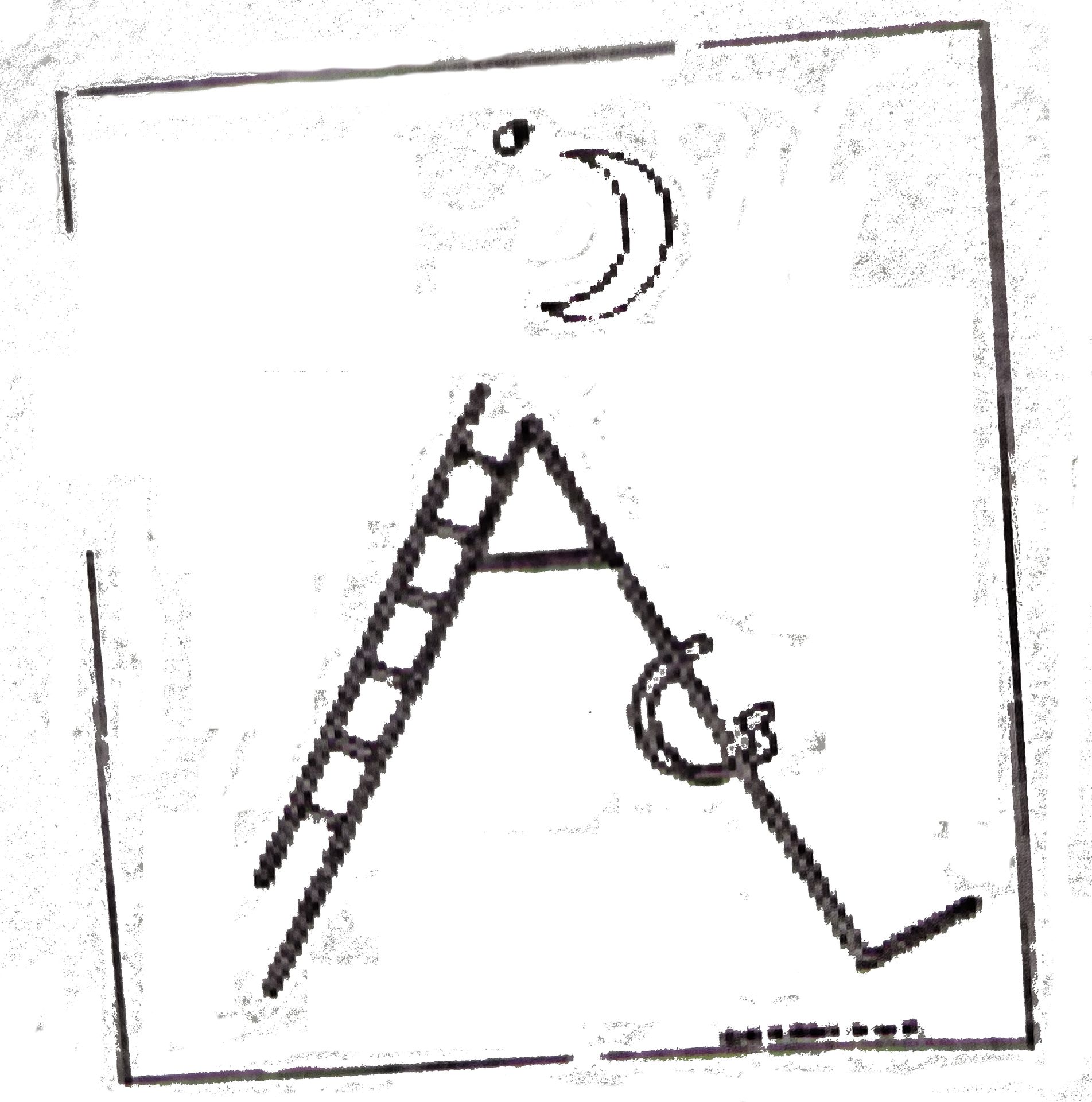
1990
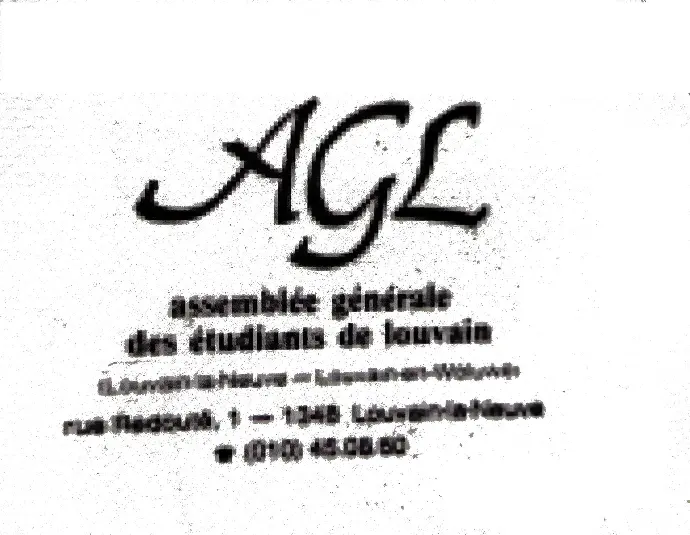
1996

2009

What will the future hold? Perhaps you will be part of it!
For that, don't hesitate to run for student elections or contact us, there is always a way to get involved with the AGL depending on the time and commitment you are willing to put in.
Opening of the Hannah Arendt room during the day
For the 2025-26 academic year, the AGL has decided to open the Hannah Arendt room as a daytime welcome space.
We have provided a sofa area, a shared library, a coffee machine, and even a foosball table.
Call Alice
In 2024, driven by the AGW, the "Call Alice" project is born. It consists of a secure, free, and anonymous taxi line allowing a victim of VSS to be taken to the nearest CPVS.
Subsequently, this project will be extended to the Saint Louis site and eventually regionalised at the level of the Brussels region.
The project will arrive in 2025 at the Louvain La Neuve site under the name "Call Ariel".
2024
Merger with Saint Louis (and the CAU)
After several years of negotiations and discussions, UCLouvain and the University of Saint Louis Brussels merge despite the reluctance of the AGL and the CAU.
Once the merger is effective in 2023, the Student Councils will also merge, making the CAU the 5th Site Council after Woluwe, Tournai, Mons, and Saint Gilles.

2021
Free psychological support
During the pandemic, free psychological support was obtained. The AGL ensured that this free service would be maintained.
Abandonment of negative marking MCQs.
After several years of lobbying by the AGL within university bodies, UCLouvain announced it would abandon the use of negative marking MCQs starting from the January 2021 session.
The student argument was based, among other things, on the fact that many students might not answer questions for which they actually had the answer for fear of losing points. This therefore created a gender discrimination during the evaluation, women being more prone to the risk aversion.
Le Soir - Exams: UCLouvain removes negative marking in MCQs
UCLouvain - No more negative marking in MCQs
Fossil Free
This year, the transition committee has worked on the decarbonisation of UCLouvain's investments.
 On 22 October 2017, the AGL positions itself for the University to no longer invest in fossil fuels. This is the start of the campaign Fossil Free.
On 13 June 2018, the AGL proposes the note to the board of directors of UCLouvain. The board then decides to stop investing in fossil fuels but does not decide to divest.
On 21 November 2019, given the slow progress of the file and still the absence of a decision on divestment, the AGL remobilises and organises the Sit-in: Fossil Free UCLouvain.
In 2020, UCLouvain adopts a timetable so that by 2022 100% of investments are sustainable.

TVCOM - AGL denounces investments in fossil fuels (21/11/19)
Abandonment of TestWe
The beginning of 2020 is marked by the arrival of the pandemic of Covid-19 in Europe, the first cases will soon arrive among the UCLouvain community and the closure of the University will follow shortly after. Classes are taught remotely but so are the exams. Many students are uncomfortable with TestWe, a tool used for exams aimed at preventing students from cheating by completely blocking the computer as well as regularly capturing images via the webcam to ensure that the student is alone and not consulting their notes. Many are concerned about the respect of their privacy or that the software may consider a misplaced glance away from their screen as cheating. Numerous technical issues with computers have also been reported.
The AGL will obtain the abandonment of the software from the second session of remote exams.
The future - The AGL is asking UCLouvain to completely abandon the use of TestWe (27-05-2020)
Occupation of the rectorate
In June 2017, a modification of the Landscape decree was voted allowing higher education institutions to freely charge up to 15 times the amount of the basic tuition fee to international students, which could amount to €12,525.
Several Student Councils immediately declared their firm opposition to this increase, the first barrier against the increase of tuition fees for Belgian students.
For 2 weeks, AGL students occupied the rectorate to firmly support their demands which were as follows:
- A relaxation of the success criteria for non-EU students
- An extension of the countries exempt from increased fees
- A commitment not to increase the tuition fees beyond the existing ceiling
Simultaneously, an occupation was also taking place at the ULB rectorate.
This action is considered as a major event in student representation in Belgium. It had been 30 years since an occupation had been used as a means of action, and the previous double occupation dated back to May '68.
A 5-year freeze on the file has been achieved. A victory, certainly temporary, but a victory.
Note :
All of this lasted 8 years. In 2025, the tuition fees for international students will be increased, and the government announces the increase of tuition fees for Belgian students.
The struggle continues ...


7 days a week - The occupation of the UCL and ULB rectorates extended
2012-13
Dish of the day, Post' and record in the elections
A notable victory to remember, the establishment of the dish of the day at €3 at the Resto U.
A new activity room will be created, the Post' (now the Joanne Simpson room) becomes the 4th activity room managed by the AGL (this number will drop to 3 a few years later following the recovery of the Salmigondis by the University to turn it into a lecture hall).
Another fact to note is a record for the student elections with a participation rate of 35.26%, still unmatched to this day.
First Co-presidency, second departure from the FEF, Student Representation Forum and night without activities
David Mendez Yepez and Antoine Saint-Amand will inaugurate the first co-presidency of the AGL.
That year, after new disagreements, the AGL will leave the FEF again. However, it will remain very active at the community level by getting fully involved in discussions around the student movement. It will return to the fold of the FEF the following year following the election of David Mendez Yepez as its head.
The second semester will see the holding of the Student Representation Forum, which will aim to clarify the roles of the different student representation bodies at UCLouvain (AGL, BDE, CGEI,...).
A significant event of that year was the night without activities, on Thursday 20 October, the animation collectives, supported by the AGL, decided to stop all their activities in order to denounce the city's policy deemed too repressive towards student activities. The rallying cry was: "Since activities seem to be the problem, we propose that the city do without them for one night...".
The result of this action will be a sacking of the city with numerous acts of vandalism, with damage estimated at over €8000. This will be condemned by the 4 collectives (AGL, Fédé, Organe, GCL) who will take the opportunity to remind of the importance of activities managed by the collectives, which are strictly regulated by various agreements. This action will help to restart the dialogue between the municipal authorities and the animation collectives.
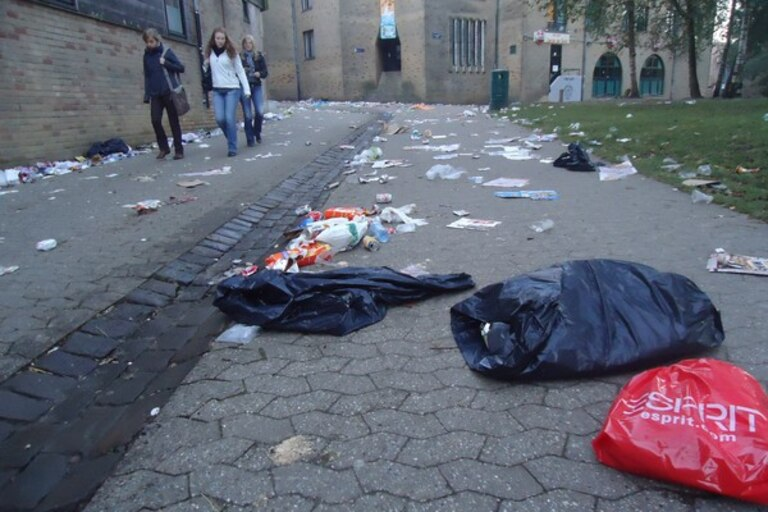
CP : A night "without" animation in Louvain-la- - Louvainfo
Creation of the AGW
For the year 2010-2011, theGeneral Assembly of students from Woluwé is created at the request of local advisors. This is therefore the first Site Council of the AGL.

First electronic election
The student elections of 2010 will see a major change, it will be the first online elections with encrypted voting not only for the AGL but also in Wallonia for as many voters.
These will be implemented in collaboration with Professor Olivier Pereira as well as the company Bluekrypt which still today ensures the conduct of our annual elections. As for Olivier Pereira, he remained an active member of the electoral commission until 2023 to ensure technical follow-up.
First rectoral election
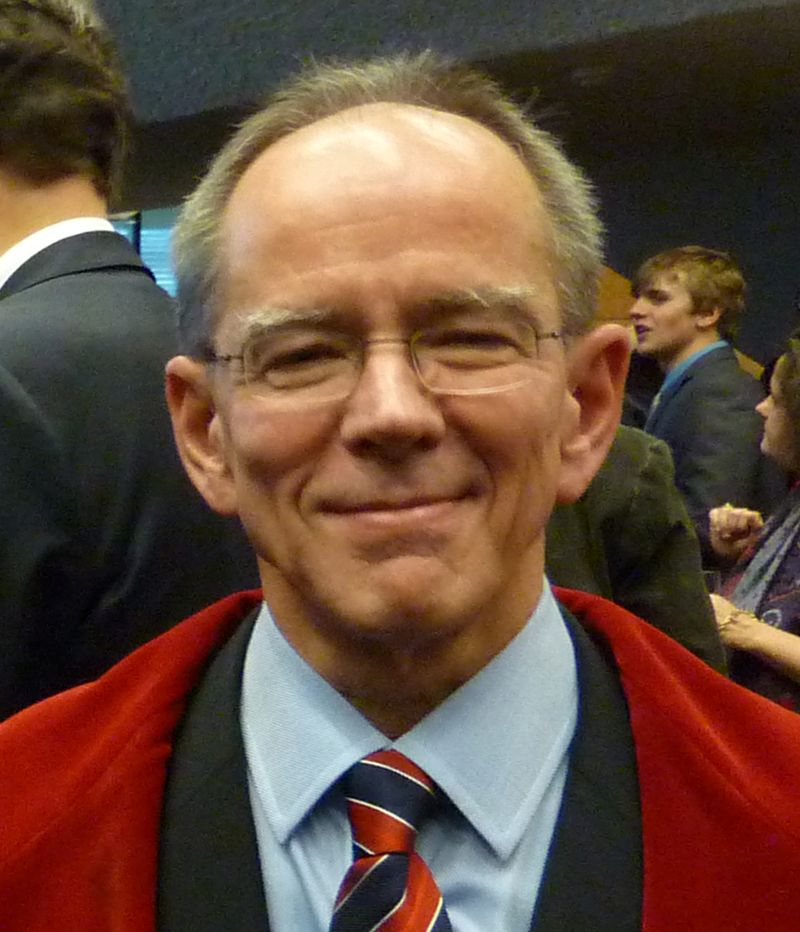
This year is marked by the first rectoral election, until then the rector was appointed by the cardinals of the Organising Authority. The AGL will organise conferences, publish a special pamphlet, distribute leaflets to involve students as much as possible in the choice of the person who will lead the University.
It is Bruno Delvaux, dean of the Faculty of Agronomy, who will become the first elected rector.
Blocking of the social budget, colloquiums and demonstration for the animation
In the first semester, the AGL obtains a review of the major and minor system and requests the generalisation of access to the latter. It also achieves better individual follow-up for the repeating students who are a bit lost among the various reforms implemented.
At the CASE, the student delegation votes against the social budget and thus prevents its approval. The AGL justifies this decision by a lack of investment in social projects in favour of the general budget of the University.
Shortly before, the AGL, accompanied by the circles and regional groups, gathers more than 3,000 students in the streets to demand more flexibility regarding night-time activities.
During the second semester, three colloquiums will be organised: one on teaching, a second on university cooperation policy for development, and a third on the place of students on the Louvain-La-Neuve site.
Participation Decree
On 12 June 2003, the Decree relating to student participation and representation in higher education known as the Participation Decree. This defines student councils and community representation bodies and clarifies their rights, duties, and functioning. It guarantees, in particular, a minimum presence of 20% of students with voting rights in university bodies and 50% in the social council. It will come into its current form on 21 September 2012.
This decree also guarantees that student representatives cannot be sanctioned for actions taken in the exercise of their mandate or because of it.
Housing and tension with the activities
That year, UCLouvain wishes to change the rental contracts for the kots to 12 months instead of 10 months, the student delegation of CASE (Council for Social and Student Affairs) manages to prevent the measure and obtains a moratorium on any direct or indirect increase in rents. In exchange, it was agreed to renegotiate the subsidies for activities and a proposal to increase the price of beer. Some tensions will therefore arise with the GCL and the Fédé who fear for the survival of the smaller activity collectives. These tensions will lead to a list from members of the activities standing for student elections.
First departure of the FEF
That year is marked by the departure of the Federation of French-speaking students from the AGL. The cause is a divergence of vision regarding how to defend student rights, with the AGL wanting more grassroots actions while the FEF was more focused on the institutional.
It will make its return in 2001.
Withdrawal from university bodies
During the academic year opening speech, Christophe Derenne, president of the AGL, announces the withdrawal of the representatives decision-making bodies of the University. According to the AGL, the University does not require the AGL to be representative, it simply needs a student perspective, no matter which. The AGL will want to return to the student community and will also turn to researchers and academics. From these exchanges will emerge the establishment of meta courses (aiming at interdisciplinarity) and mixed courses (aiming at interculturality).
First president and visit of Pope John Paul II
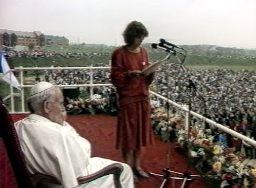
The academic year 1984-85 will see the AGL have its first president in the person of Véronique Oruba.
A significant event of her term will be the visit of the Pope John Paul II on 21 May 1985. During this visit, she will be required to give a speech with the pope in front of a crowd of 30,000 people, she will deviate from the planned speech to address topics and positions that disagreed with those of the Church at that time. Although the pope will commend her courage and the quality of her speech, the rector Mgr Édouard Massaux will decide to exclude her from the University.
She will be reinstated the following year by Pierre Macq, the first lay rector, in order to complete her studies.
In total, by 2026, the AGL will have had 14 presidents.
40 years ago, Véronique Oruba gave a historic speech in front of the pope | TVcom
Second rent strike
In March 1984, the AGL supported by the circles, the regions as well as the Body calls for a rent strike of UCL housing to protest against yet another attempt by the authorities to cut the social budget.
This strike consists of freezing payments and making the payments once an agreement is reached with the Board of Directors.
The strike will be lifted in early May, an agreement having been reached, the students accept the savings decided by the Board and in exchange the stability of the social budget's revenue is guaranteed until 1989.
La Flaque No. 24, week of 2/4/89
The AGL sues the University
The AGL, through its president Yves Delacollette, sues UCLouvain in court before the court of Wavre, accusing them of breaking the rental contract of certain students in order to urgently accommodate many seminarians. The court will rule in their favour.
Competence of the Social Council
This year begins with the unilateral decision of the administration director to withhold 10% of the awarded scholarships from the Social Centre. The AGL managed to impose on the Board to lift this measure.
At the same time, the AGL reaffirms the absolute competence of the Social Council for all decisions in the social sector.
The projected deficit by 1985 for the social budget is 230 million Belgian francs, this due to reductions in state subsidies and a surge in energy prices.
Following negotiations between the AGL (via the social council) and the Board, an additional contribution of 35 millions par an par l'Université.
In return, rents will be increased to cover cleaning costs, the budget for activities will be reduced by 25%, and the university restaurants as well as LOGE will need to increase their revenues.
La Flaque no. 14 & La Flaque no. 27 (AGL periodicals available at the UCLouvain archives service)
First rent strike
At the beginning of 1979, a notice of rent strike is issued until the tenants' general assembly. The main demand is the creation of a single lease agreement for all real estate agencies. Until then, the general assembly calls on tenants not to pay their rent.
The single lease will be approved by the general assembly and the agencies on 28 March 1979.
AGL report 1978-79 (La Flaque, concrete no. 26)
Birth of the GCL and the powers of the AGL Council
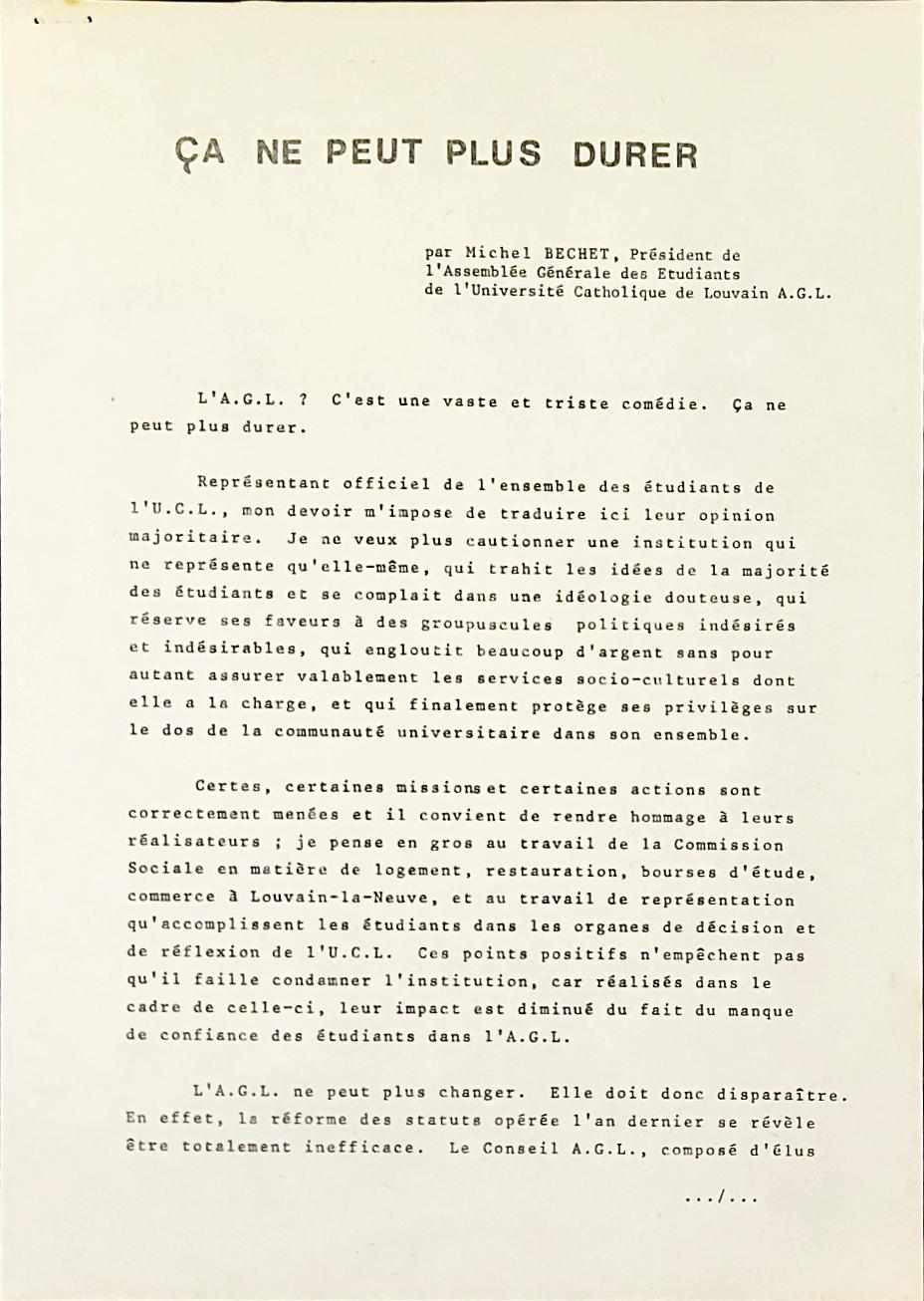
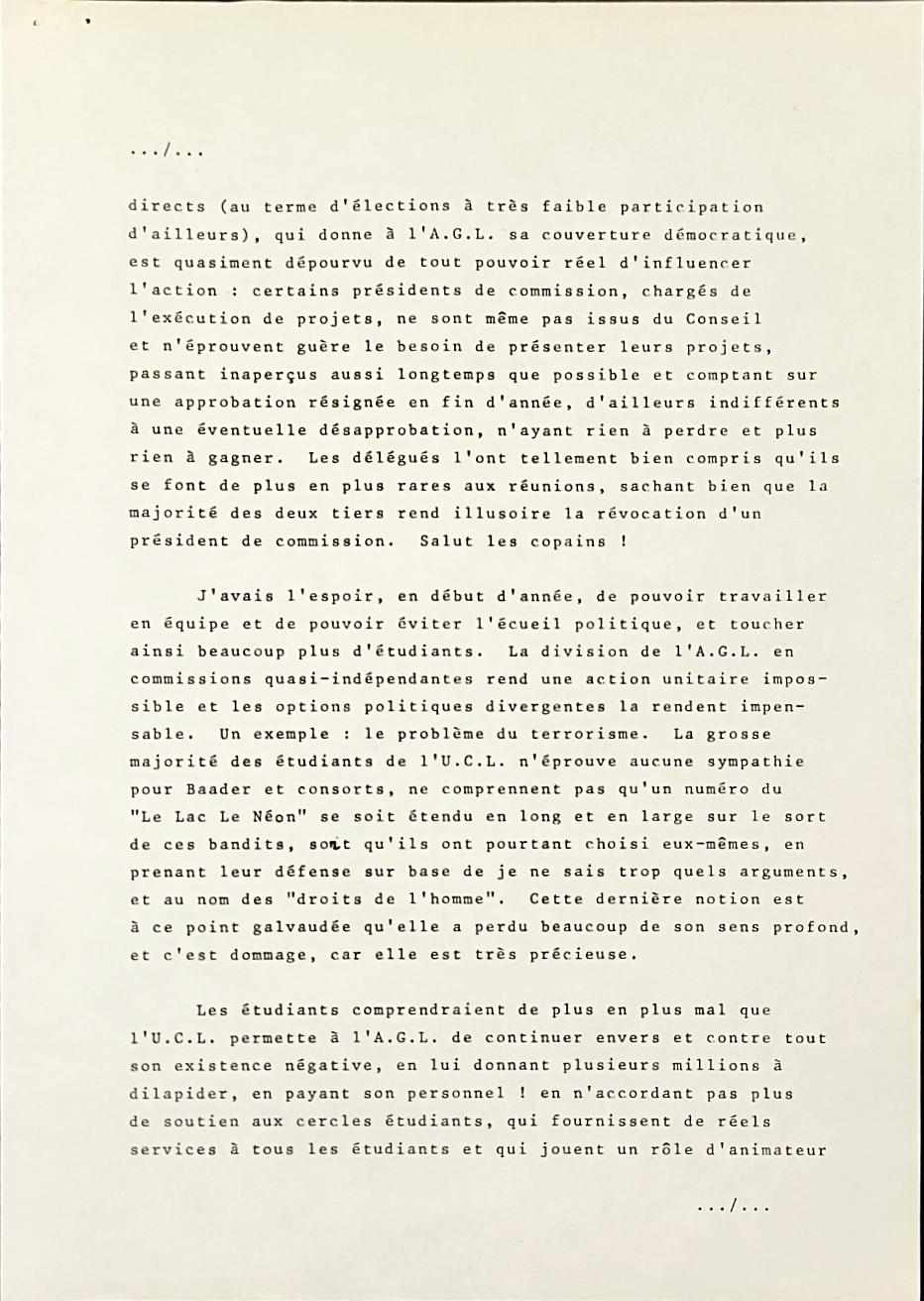
That year, Michel Bechet, then president of the AGL, sent a letter to the students stating that the AGL was deeply dysfunctional and that the best course of action would be to dissolve it and transfer its responsibilities to the student circles. Following this, he dismissed all the vice presidents despite the opposition of the executive committee and the Council. Since the appointment of the board and the committee falls under the president’s authority, no one could stop him. On October 24, 1978, a resolution was adopted granting the AGL Council the authority to appoint the board and the committee, as well as to define their actions. This laid the foundation for the AGL Council as we know it today, which serves as the AGL’s sovereign body.
On 23/11/1978, a letter was sent by the Association of the Louvain Circles (ACL, which would later become the GCL) announcing its creation and affirming its support for the AGL by recognising the need for a central student movement that they saw embodied by the AGL.
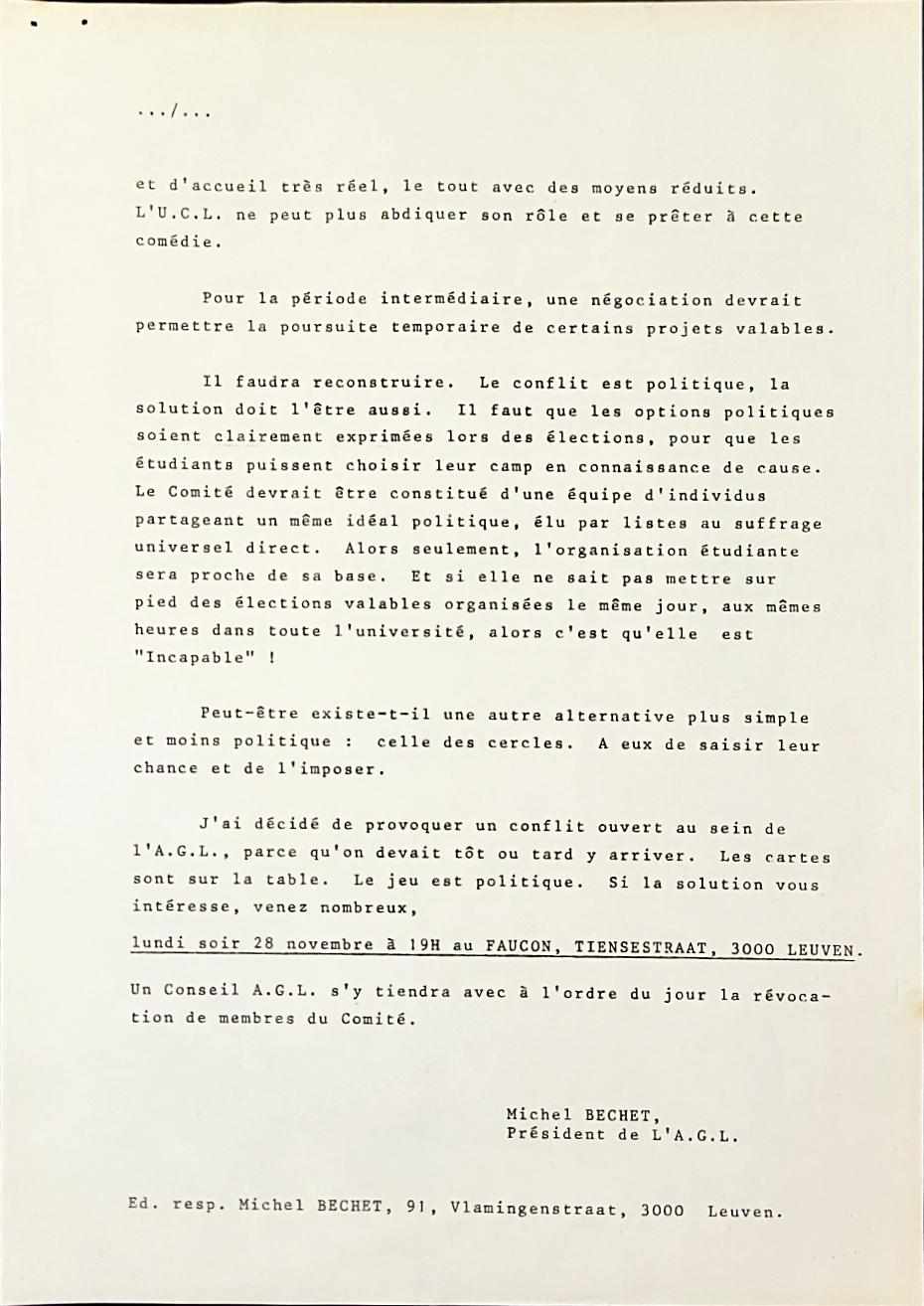
AGL Activity Report 1977-78 and Letter from Michel Bechet
Visit of King Baudouin to Louvain La Neuve
Second visit to Louvain-la-Neuve in 2 years for the King Baudouin, this time on the occasion of the centenary of the Agro Circle.
During his first visit, a white paper had been handed to him, expressing concerns regarding the Michel decree (named after Joseph Michel, then Minister of National Education).
For the second visit, the president of the AGL, Pierre Guislain, will hand him a letter, which explains that despite the white paper, the situation has further deteriorated for students.
The letter expresses, among other things, the high cost of living in Louvain-La-Neuve, the concerns for the most disadvantaged students due to the doubling of the tuition fees, the desire to replace social aid with student loans (with interest rates ranging from 4 to 8%). It also expresses concerns related to the increase in power granted to the executive and the decrease in operating grants awarded to the University, which will result in a reduction of budgets related to the social sector and research.
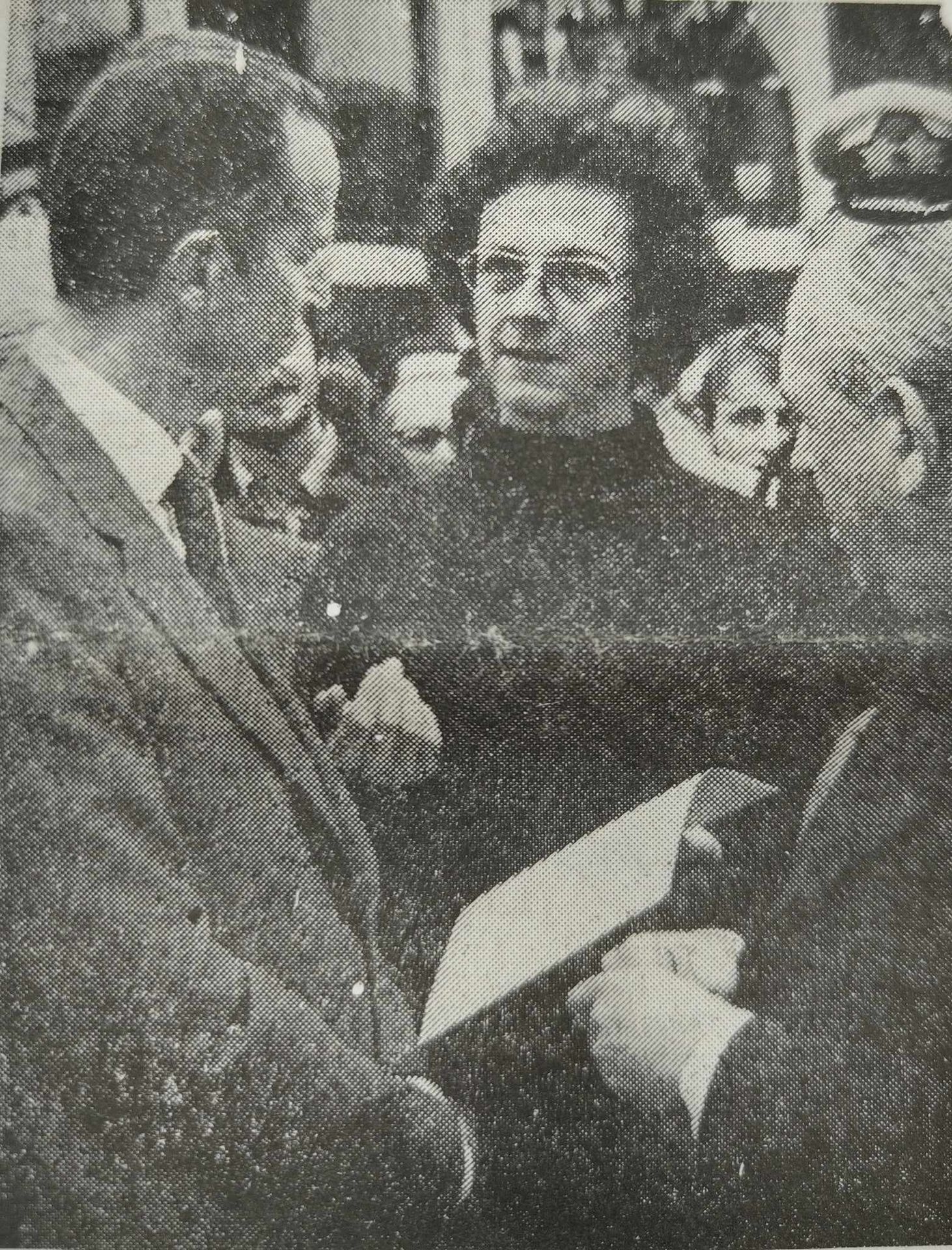
Delivery of the letter to the King by Pierre Guislain in the presence of the rector Mgr Edouard Massaux.
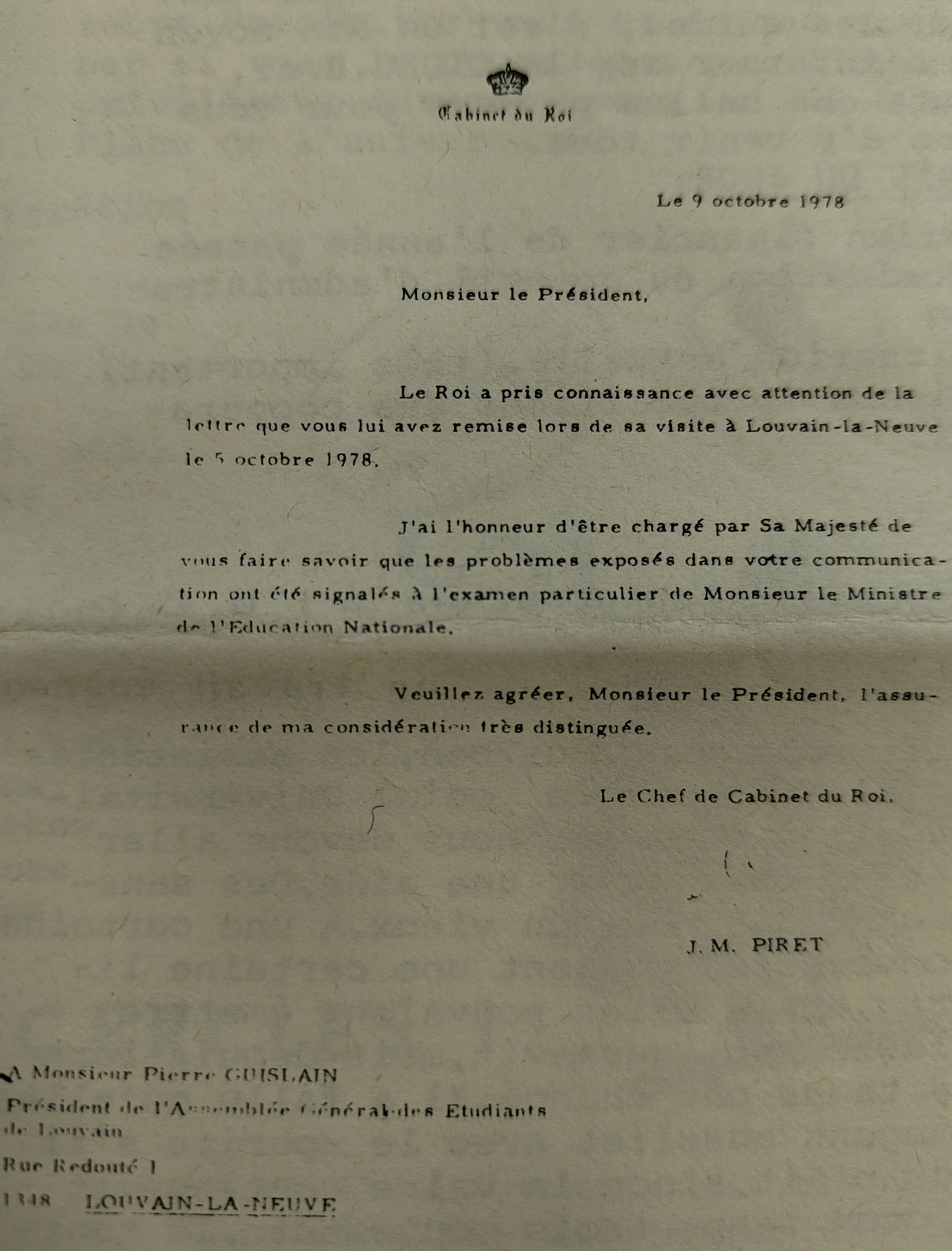
Response from the King's Cabinet
Le Soir - Article of 9/10/1978
Creation of the teaching commission
During the month of February 1978, the first teaching commission will be held. The objective is to gather the faculty delegates in order to address common themes related to pedagogy in the University.
Just like the social commission, the teaching commission is still active today.
Move to Louvain-La-Neuve
In 1976, the AGL moved from Leuven to Louvain-La-Neuve at 65 Rue des Wallons (current building of the LUX and the Fédé). The following year it will move again to 1 Rue PJ Redouté (opposite the current Law Circle).
It was not until the start of the 1995 academic year that it returned to Rue des Wallons, this time at 67, where it is still located today. The official address will change to 35 Avenue Georges Lemaitre in 2024, but it remains the same building.
Birth of the CIACO
In 1970, the student organizations at UCL (which was still based in Leuven) decided to establish CIACO, a cooperative whose mission was to provide students with educational materials and stationery at affordable prices.
Two years later, it faces serious financial difficulties and is narrowly saved thanks to financial contributions, notably from the AGL.
In 1973, the first CIACO store opens in Louvain-La-Neuve in the Galilee square (in place of the Dude) and in 1974 a store is opened in Woluwé.
The DUC was founded in 1980.
Foundation
Founded in 1961, the General Union of Students was established to serve as a counterpart to the Walloon Federation of Students of Louvain, which brought together the regional student associations. The UG, for its part, brought together members of the faculty circles who wished to engage in “student activism,” focusing on the democratization of higher education, student participation, and a reform of the curriculum (which was considered too lecture-based). In 1963, it was renamed AGEL, then AGL in 1967.
The 1960s will be marked by tensions with Flemish nationalist groups, who notably hindered the proper conduct of classes in French and protested against the presence of French speakers in Leuven. In 1967-68, the "Walen Buiten", a political crisis erupted that would lead to the construction of Louvain-La-Neuve starting from 1971.